Skip to content
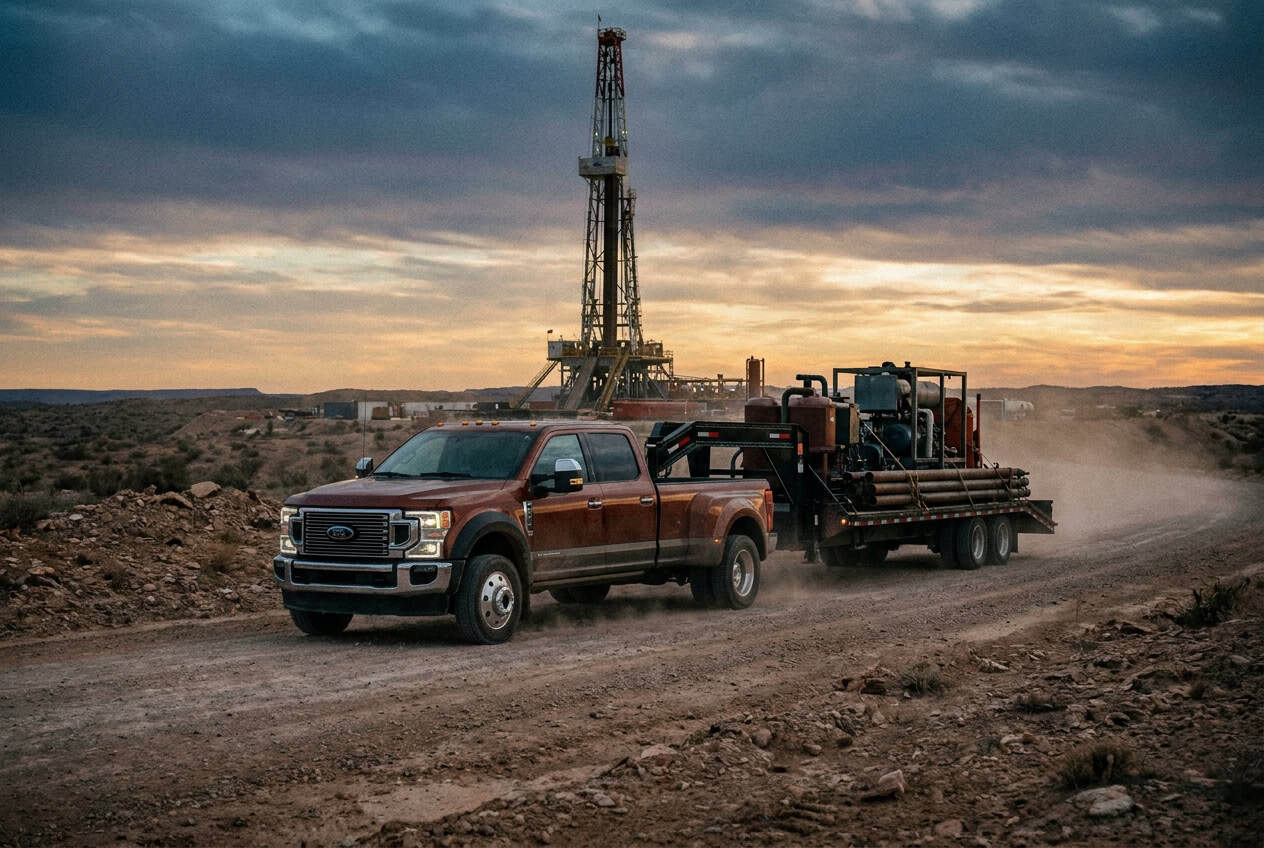
Oilfield drilling operations run on tight maintenance schedules, and one missing part can cause costly downtime, especially at remote well sites. When critical tools or replacement parts are hundreds of miles away, standard freight is often too slow.
That’s where specialized oilfield hotshot services come in. These rapid-response trucking solutions help keep operations moving by delivering essential equipment fast and reliably.
This guide explains what oilfield hotshot trucking is, what types of equipment it moves, why speed matters, and what to know about regional challenges, DOT compliance, carrier vetting, and pricing.
What Is Hot Shot Trucking in the Oil and Gas Industry?
In the oil and gas industry, hotshot trucking is the expedited, on-demand delivery of time-sensitive freight using medium-duty trucks and specialized trailers to active drilling and well sites. Unlike standard LTL or FTL shipping, these loads move directly from pickup to destination without terminal delays or scheduled-route stops.
Key advantages include:
- Speed: Minimizes downtime by avoiding standard freight consolidation.
- Routing: Moves point-to-point with direct delivery and GPS tracking.
- Accessibility: Reaches rural roads and tight lease entries more easily than traditional semis.
Third-party logistics providers and specialized carriers use this model to support urgent oilfield operations across interstate networks.
What a Hotshot Truck Moves to Stop Lost Production
Securing the right hotshot truck or heavy vehicle depends entirely on the correct classification of your time-critical freight.
Common oilfield equipment categories require precision handling from expert hotshot drivers and immediate dispatch capabilities to prevent lost production for oil and gas operations.
- Equipment and Hardware: Drill bits, casing subs, valves, and specialized downhole tools require fast, precision transport because they lack functional substitutes on-site at the oil field.
- Electrical and Mechanical Parts: A broken mud pump, motors, pressure sensors, and circuit boards serve as single components that cause major oilfield equipment failure when unavailable.
- Safety and Jobsite Supplies: Critical safety supplies, protective equipment, high-grade fire extinguishers, and large spill kits are regulatory necessities.
- Support Tools and Trailer Loads: Pipe stands, support tools, specialized welding equipment, and portable generators keep oil and gas companies’ operations productive.
A delayed delivery for any of these vital replacement parts translates directly into massive expenses, maintenance downtime, and schedule challenges for gas companies. These high-stakes downtime challenges are outlined clearly in our next section on business operations.
Why Expedited Trucking Matters in Oil and Gas Company Operations

Every business logistics truck decision in the oil patch ultimately circles back to keeping rig maintenance schedules active. When a vital oilfield equipment component breaks down, transit speed, reliability, and truck capacity are the primary transportation metrics that preserve the project budget.
Minimizing Downtime and Avoiding Revenue Loss
A single active drilling operation generates massive production revenue continuously in the oil industry. Idle downtime erodes that figure hour by hour through severe schedule disruptions, so minimizing downtime is a vital service.
According to federal energy analysts, equipment expenses and rig-related costs can range from $0.9 MM to $1.3 MM, making up 12% to 19% of a well’s total cost. These expenses strictly depend on operational drilling efficiency.
Rapid expedited trucking services prevent this massive financial operational failure from escalating further. Paying for reliable expedited trucking functions strictly as immediate cost recovery rather than an operational expense for any truck.
Urgent Hot Shot Deliveries for the Oil and Gas Industry
Oilfield trucking emergencies do not follow traditional business hours. Critical breakdowns frequently happen late on a Sunday night or in the middle of a major weather event, prompting hotshot truck dispatch urgency.
Hotshot dispatch operates strictly on emergency timelines with instantaneous truck pickup execution. This on-demand capability fundamentally separates hotshot operations from heavily scheduled national freight network routes.
Remote Locations and Extreme Oil Field Infrastructure
Active operations frequently sit on unmarked rural roads, private ranch land, or miles beyond the nearest paved highway section. Standard carrier fleets lack the specific straight trucks or vehicle capacities to navigate securely.
Hotshot drivers with genuine local experience easily understand gate codes, lease road conditions, and intricate access requirements. Their specialized hotshot truck routing efficiency prevents unexpected shipment delays in completely austere oil field environments.
Production Delays in the Gas Industry
A single missing replacement part, like safety valves or a specialized drill bit sub, can halt gas company operations completely. Oilfield trucking functions as the rapid response contingency gap filler in the energy sector supply chain, supporting complex fracking schedules with a dedicated truck.
It acts as the structural safety net, bridging the distance from the supplier plant to the stalled drilling rig. This effectively limits the vast financial radius of unexpected equipment failures.
Safety and Trucking Efficiency
Logistics shipment interruptions consistently create business pressure on field crews to improvise. Attempting workarounds with incorrect system components greatly increases the risk of major equipment breakdowns and personnel injury.
Getting the right certified support parts on site fast via a secure truck is both a mandated safety decision and an efficiency protocol. Rapid heavy equipment transport ensures fewer freight touches and safer transit to the well site.
Time Sensitive Loads
Certain oilfield freight loads carry hard deadlines well beyond standard daily operational urgency factors. These time-sensitive loads include hazmat disposal window requirements, strict regulatory compliance, and contractual drilling schedule commitments.
A nonstop hotshot truck driver transit model guarantees there is no centralized commercial terminal where a critical shipment might miss a necessary connection. The valuable cargo stays secure in the cab or floats from the origin location to the final destination.
| Key Insight: When an active rig loses up to $100,000 per day in downtime, paying a premium for emergency hotshot truck freight isn’t an expense. It’s immediate cost recovery. |
Oilfield Hot Shot vs. Standard Freight Services
Standard freight services remain an excellent tool for general industrial materials that can easily wait. However, attempting to integrate traditional commercial trucking logistics into rig-down situations reveals structural incompatibilities for the oil and gas industry.
Regular truck shipments sit static at regional terminal locations until specific truck consolidation thresholds are ultimately met. This rigid transport network strictly follows carrier routes rather than critical gas industry operator timelines.
Furthermore, most standard freight providers totally lack true emergency pickup or reliable hotshot truck capabilities during late nights. For real business emergencies, rapid hotshot transportation services are an absolute truck requirement.
| Operational Factor | Standard LTL / FTL Freight | Hot Shot Trucking Services |
|---|---|---|
| Speed and Routing | Consolidated freight terminal dwell times | Nonstop hotshot truck point-to-point delivery |
| Remote Access | Restricted heavily to paved highways | Equipped specifically for unpaved roads and lease entries |
| Dispatch Hours | Standard business scheduled windows | Immediate dispatch with 24/7 clock availability |
| Cost Structure | Lower dependent capacity consolidation pricing | Premium rate yielding runtime revenue asset recovery |
Permian Basin, Texas, Eagle Ford, Bakken - Regional Considerations
Oilfield logistics vary by region. Infrastructure, weather, road access, and permitting requirements all affect how quickly critical freight can reach active drilling operations.
Permian Basin: Congestion and Cross-State Logistics
The Permian Basin in West Texas and New Mexico is one of the busiest oil-producing regions in North America. Heavy drilling activity creates constant demand for expedited freight, oversized transport, and emergency oilfield deliveries.
Carriers must manage severe highway congestion, deteriorating roads, limited staging areas, and permit coordination between Texas and New Mexico. Experienced hotshot drivers help reduce delays by navigating crowded oilfield corridors efficiently and supporting heavy haul trucking in Texas under demanding field conditions.
Eagle Ford: Rural Roads and Remote Site Access
The Eagle Ford region requires experience on rough lease roads, remote ranch access points, and dependable heavy haul trucking in Texas. Many active well sites sit far from major highways, making local route knowledge critical for urgent oilfield deliveries.
Hotshot carriers operating in Eagle Ford frequently transport pumps, generators, pipe, and welding equipment through tight access roads and unstable terrain.
Bakken: Winter Weather and Long-Distance Planning
The Bakken formation in North Dakota and Montana presents major cold-weather logistics challenges. Snow, ice, freezing temperatures, and strong winds can delay freight and create hazardous driving conditions.
Hotshot carriers in the Bakken must plan carefully for winter operations, including weather routing, equipment protection, and emergency response timing. Regional experience helps ensure critical oilfield shipments continue moving safely during severe weather conditions.
DOT Compliance and Licenses for Oilfield Hotshot Services
Regulatory compliance functions as both a strict legal mandate and a highly critical carrier vetting tool. All legitimate commercial truck operators and services must hold active authorities and licenses that are properly verifiable through official federal systems.
Many loaded hotshot truck configurations easily surpass strict transportation weight limits during routine daily dispatches. Legally, drivers must have a commercial driver’s license (CDL) if operating trucks or vehicles with a gross combination weight rating of 26,001 pounds or more.
You should rigorously verify this experience using the established federal administration truck driver portal check. Electronic logging is also deeply critical for ensuring proper documented hours of legal adherence on time-sensitive loads.
Moving drilling chemicals or flammables strictly requires specialized governmental regulatory licenses alongside placarded equipment. State laws assert that anyone carrying a placard requirement must maintain a HAZMAT endorsement on their commercial driver’s license.
Ensuring maximum carrier adherence immediately prevents severe liability risk cascading across your supply chain truck routes. State-specific overweight permits and licenses are necessary when oversize transport equipment pushes legal dimensional borders safely.
Beyond baseline minimums, rig operations must verify premium liability coverage and specific localized cargo insurance constraints. This insurance coverage must be scaled appropriately to protect extremely expensive downhole equipment components and tools during volatile truck moves.
Warning/Important: Never compromise on FMCSA rules or hazmat endorsements. Utilizing an unverified carrier for complex oilfield loads exposes your organization to massive insurance liability during a transit incident. |
How to Vet an Oilfield Trucking Company
When urgent oilfield equipment fails, you need a carrier or hotshot trucking company with proven experience. Use this framework to quickly identify qualified providers:
- Oilfield experience: Choose carriers with a proven track record in oilfield logistics, not general freight.
- Licensing and insurance: Verify federal authority, qualified drivers, and coverage that matches your cargo.
- 24/7 dispatch: Make sure they can respond to emergency loads at any hour.
- Clear communication: Look for real-time updates and a dedicated point of contact.
- Equipment range: Confirm access to flatbeds, step decks, and gooseneck trailers.
A reliable transportation partner should meet these standards before any load is dispatched.
Pro Tip: Always test a carrier’s actual availability before an emergency strikes. If their operations team doesn’t answer the phone at 2 a.m. on a Sunday, they aren’t a true oilfield logistics partner. |
What to Expect on Pricing and Lead Times for Hotshot Services
Hotshot service is not the cheapest shipping option, but it is often the most cost-effective when compared with rig downtime and project delays. Across the U.S., typical hotshot rates range from roughly $1.25–$1.75 per mile for standard loads, with urgent or specialty hauls commonly reaching $2.50–$4.00+, depending on various factors.
Pricing usually depends on:
- Distance and routing
- Fuel surcharges
- Load size and weight
- Trailer type
- Urgency, including same-day, weekend, or holiday service
Lead times vary by location, truck availability, and driver capacity. Emergency loads can often be picked up within hours, while many urgent field shipments are handled the next day. Reliable providers should offer clear quotes and realistic delivery timelines.
Titan Worldwide Logistics Oilfield Hotshot Services
In oil and gas, every minute of downtime is costly. Choosing the right logistics partner can mean the difference between a minor delay and a major disruption.
Titan Worldwide Logistics provides specialized heavy-haul trucking support for urgent oilfield shipments, with a dedicated point of contact, vetted interstate carrier options, and access to flatbeds, step decks, straight trucks, and trailers sized for your load. We also help with permitting, regulatory documentation, and clear communication throughout the move.
Our goal is simple: reduce downtime and deliver critical freight as quickly and safely as possible. Contact our team to discuss your next emergency oilfield shipment.

Ashley Hawkins is the Vice President of Business Development at Titan Worldwide and a recognized expert in heavy haul, over-dimensional, and specialized freight transportation. With over a decade of hands-on experience managing complex logistics projects across construction, energy, infrastructure, and government sectors, Ashley brings real-world knowledge to every shipment.
She works directly with carriers, project managers, and field teams to plan safe routing, secure permitting, and ensure regulatory compliance for oversize and overweight loads nationwide. Ashley’s insights are grounded in on-site experience, industry best practices, and a commitment to delivering reliable, transparent, client-focused transportation solutions.